


By Adebola Muili
Badagry may soon need a new qualification for visitors: come with your documents—and verify everything else.
First, there was the alleged lawyer who reportedly turned up in court without the legal credentials he was said to possess.
Then came the alleged university that apparently had no accreditation.
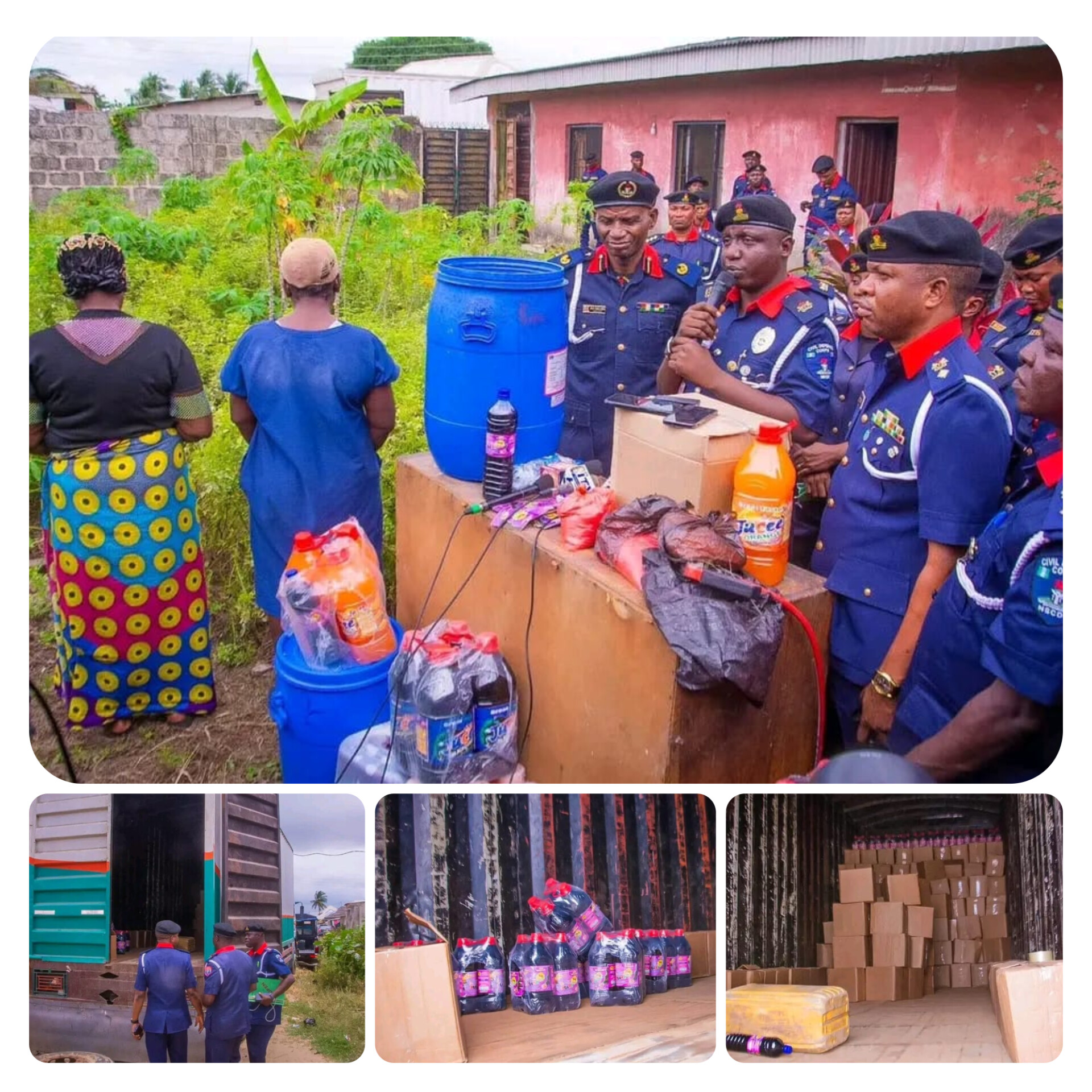
Next was the fruit juice factory where, according to the NSCDC, the advertised fruit was nowhere to be found in the recipe.
And now, the police have uncovered a suspected factory where alcoholic drinks were allegedly being produced and packaged outside the law.
All in Badagry.
At this point, the question almost asks itself: Is Badagry becoming synonymous with fakery?

Before the good people of the historic border town start protesting, this is not an indictment of Badagry.
The town has enough genuine history to fill several textbooks. Its cultural heritage, landmarks and communities are not products of some overnight manufacturing process.
But the recent run of enforcement operations is certainly making for an unusually entertaining—and troubling—chapter in the town’s crime reports.
It started, at least for this particular sequence, with the alleged lawyer.
In January 2025, a man identified as Godwin Eguabor was reportedly arrested after allegedly appearing before a Badagry Magistrate Court as a lawyer.
The Badagry branch of the Nigerian Bar Association reportedly questioned whether he was actually a legal practitioner, leading to his arrest and subsequent legal proceedings over the alleged impersonation.
A lawyer whose own credentials allegedly needed to be checked.
Then came the university.

In July 2026, the Lagos State Command of the Nigeria Security and Civil Defence Corps (NSCDC) announced the discovery of an alleged unaccredited university in Imeke village, Olorunda Local Council Development Area of Badagry.
The institution, whose name was withheld, was allegedly offering admissions into unapproved courses, including nursing.
The NSCDC said 18 suspects were arrested and 125 people rescued.
According to the Corps, some of those rescued had allegedly been lured with promises of admission before being drawn into a Ponzi-style arrangement in which participants were encouraged to recruit others for financial rewards.
At least the students were apparently looking for something real: education.
Then Badagry moved into the beverage business.

In September, NSCDC operatives announced the arrest of two women over the alleged production of fruit juice at an illegal factory in the area.
After about five days of surveillance, the operatives reportedly raided the facility.
And what did they allegedly find?
According to the Corps, the product labelled “Barkas Juice” was being produced by mixing water with synthetic flavourings, industrial sweeteners, artificial colourants, dyes, preservatives and other additives.
Real fruit, according to the allegation, did not appear to be part of the guest list.
The product was also allegedly being distributed to markets in Lagos, Benin City and other parts of the country.
Then, just when one might have expected Badagry to take a break from the business of things-not-being-quite-what-they-seem, the wine arrived.
On September 24, the Lagos State Police Command announced the discovery and sealing of a suspected illegal factory in Yafin, Badagry.
A 48-year-old man, Anaebo Emeka Hilary, was arrested.

Police said they recovered suspected adulterated alcoholic drinks, empty bottles, assorted wine labels and other materials allegedly used for production and packaging.
And there it was.
The Badagry collection:
A lawyer whose credentials were questioned.
A university whose accreditation was questioned.
A juice whose contents were questioned.
And wine whose authenticity was questioned.
Different cases. Different suspects. Different agencies.
But the same uncomfortable question keeps returning:
What exactly are we buying, enrolling in, drinking or trusting?

The humour may be irresistible, but the underlying issue is not funny.
The alleged university case involved people seeking education and opportunities. The juice and alcoholic-drink cases potentially affect consumers. The alleged lawyer case touches on the integrity of the legal profession.
In each instance, someone allegedly relied on another person’s claim that something was what it appeared to be.
And that is where the joke ends.
Because a student can lose money and precious time by enrolling in an unapproved institution.
A consumer can unknowingly purchase a product whose contents are not what the label suggests.
A client can put a legal matter in the hands of someone whose professional credentials are allegedly questionable.
So perhaps the real Badagry lesson is not that the town has suddenly become the capital of fakery.
It is that fraud can be remarkably creative—and trust remains one of its favourite raw materials.
There is also something almost poetic about the location.
Badagry is a town whose history is deeply connected with movement, trade and the meeting of people from different places.
Today, security and regulatory agencies are having to ensure that what moves through the town—from certificates to beverages—is what it claims to be.

The recent operations also show the value of intelligence gathering and community cooperation. In the cases announced by the NSCDC and police, information, surveillance and coordinated enforcement led to arrests, recoveries and the closure of suspected illegal facilities.
The suspects, of course, remain entitled to due process, and the allegations must be established through proper investigation and prosecution.
But for now, Badagry has inadvertently produced a rather unusual storyline.
One case involves credentials.
Another, admission.
Then juice.
Now wine.
At this rate, perhaps the safest thing to carry around Badagry is not a shopping bag but a verification checklist.
Because the town itself is real.
Its history is real.
Its people are real.
But if the recent reports are anything to go by, checking whether everything else is what it claims to be may not be such a bad idea.
Discover more from SAFARI XPRESS NEWS
Subscribe to get the latest posts sent to your email.











Leave a Reply