

By Adebola Muili
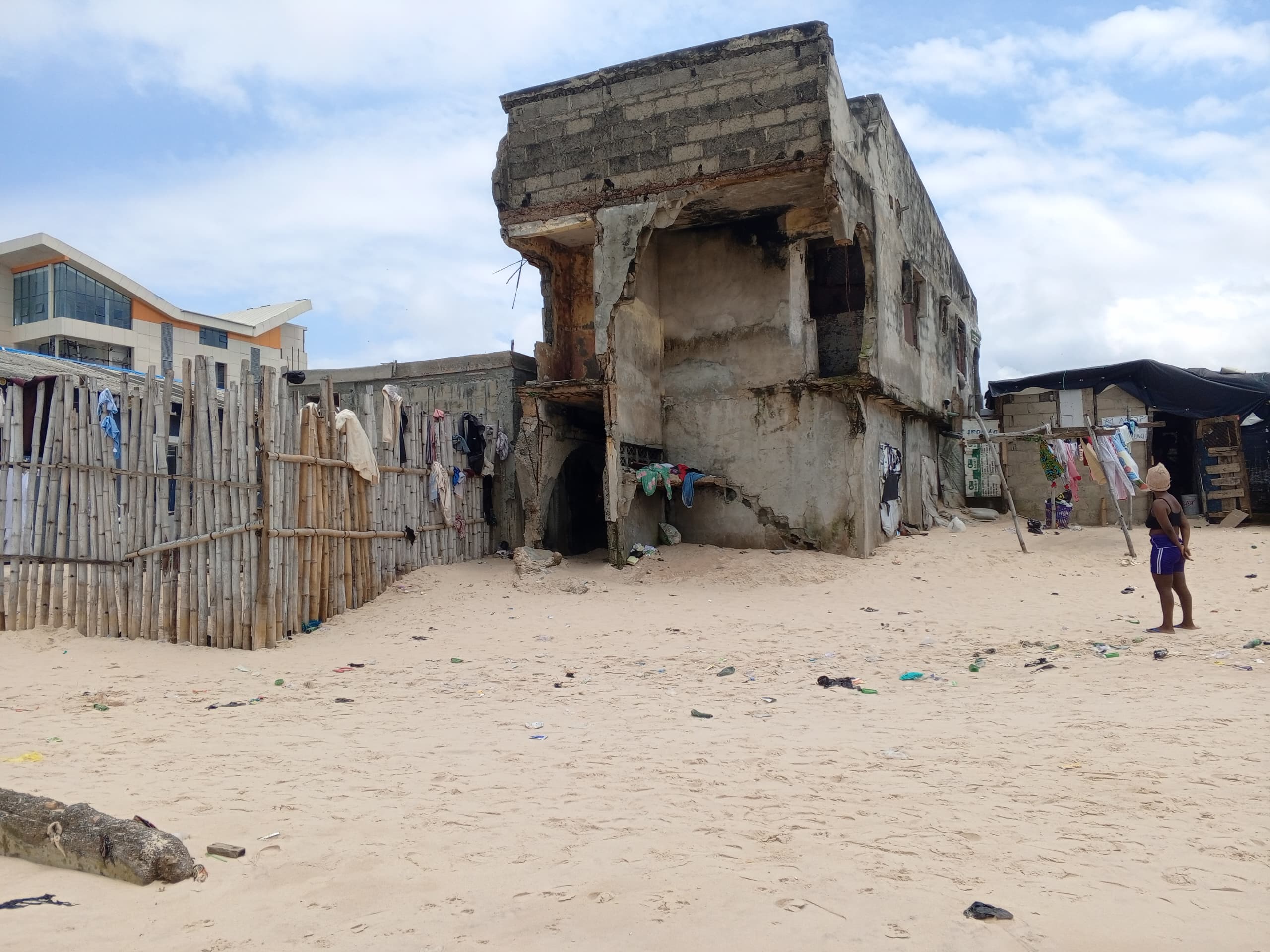
For generations, the people of Okun Afa Community, also known as Afa Community, around the Alpha Beach axis of Ibeju-Lekki, Lagos, have lived with the sea as both a source of livelihood and an ever-present threat.
But what was once a distant shoreline has steadily moved closer, swallowing homes, farms, shops and public facilities and forcing the community to relocate repeatedly.
Today, residents say they are living in their fourth settlement, with increasingly limited space for further relocation as the ocean advances and major coastal infrastructure developments reshape the area.
Their plight has brought into sharp focus a difficult question about development: what happens when infrastructure projects designed to stimulate economic growth impose unbearable costs on communities in their path?
The question emerged during a visit to Okun Afa, also known as Afa Community, by the Hope Newspaper Correspondent in the course of researching the social and environmental consequences of extraction.
Residents told our reporter that the place where they live today was not their original settlement.
According to them, their ancestors had occupied earlier settlements closer to the sea, but repeated ocean incursions forced them to move further inland.
One resident described the distance between the community’s earlier settlement and its present location as comparable to travelling from the present area towards the Marina axis of Lagos.
With each relocation, however, the community has lost more of its ancestral land.
The current settlement is reportedly the fourth, and residents fear they may soon have nowhere else to go.
The Community Development Association (CDA) chairman, Hon. Prince Sheriff Adekunle Elegunshi explained that the community was historically established more than 200 years ago and that previous generations had repeatedly moved as the ocean consumed their settlements.

He said the situation had now reached a critical stage because the community had little room left for further relocation.
“We are at the centre now. There is no way we can say we will relocate or move to the upland,” he said.
For the residents, relocation is not simply a matter of finding another piece of land.
It is about preserving the identity of a people.
They fear that moving into another community could mean losing the name Okun Afa, their traditional institutions, customs, culture and collective identity.
When Development Comes at a Cost
The residents’ accounts raise concerns about the unintended consequences of large-scale coastal development.
The dredging and movement of sand associated with major projects, according to accounts obtained during the field visit, have become a source of concern among residents who believe changes to the coastline have worsened their predicament.
Among the projects cited were the development of Eko Atlantic and the Lagos-Calabar Coastal Highway, major infrastructure projects presented as catalysts for economic growth and improved connectivity.
For communities such as Okun Afa, however, residents say the benefits of such projects have not matched the losses they have suffered.
As one observation from the field visit put it, “As good as these projects are, they come at the detriment of some people. Some people are in pain while others are having to enjoy this infrastructure.”
Residents said the government had previously intervened with shoreline protection measures, including the construction of wave breakers, which they acknowledged had reduced the force of the waves.
The community also recalled an intervention by former Lagos State Governor, Babatunde Raji Fashola, in response to its coastal challenges.
But residents insist that the protection is no longer sufficient.
The CDA chairman said the government needed to extend the wave breakers and undertake comprehensive reclamation of affected areas.
“The wave breaker is not enough. The water still comes up from time to time,” he said.
He also called for proper drainage channels to convey rainwater away from the community into existing waterways.
According to him, although there is a canal behind the community, there is no effective drainage channel linking the settlement to it.
Homes, Schools, Worship Centres Swallowed
The scale of the losses is reflected in the buildings residents say have disappeared.

According to the CDA chairman, the advancing sea has swallowed homes and commercial structures as well as community institutions.
Among those affected, he said, were health centres, primary and secondary schools, churches and mosques.
Mrs. Okonlawon Kazim, a food and fish seller, gave a personal account of the destruction.
“My father was a native of this town. The house that was my father’s house — the sea has carried it away. The house that was my mother’s house is still up there, but it too is collapsing and falling,” she said.
For Kazim, the destruction is not merely the loss of property.
It is the disappearance of the place she calls home.
“We have no other town. As for me, I have no other town — no mother’s town elsewhere, no father’s town elsewhere,” she said.
She added: “What has happened to me should not happen to my children.”
The Farms Are Gone
Before the sea advanced, residents said agriculture provided an important source of food and income.
Kazim recalled growing up around mango, cassava and coconut farms.
“When I was going to school, if we went out in the morning, we would first go pluck mangoes from our farm,” she recalled.
“We had a cassava farm; we made gari, we did everything. There was nothing missing, including coconut.”
Today, she said, there is virtually no farmland left.
“But now there’s nothing anymore. There’s no farm, no gari, no anything. There isn’t even land left for us to plant anything on — the sea has consumed all of it.”
Fish Trade Disappears
The destruction has also crippled fishing and fish trading, once important economic activities in the community.

Kazim said she started selling fish in 1993 and continued for about three decades before abandoning the trade.
She said fishermen previously brought their boats to landing points where traders bought fresh fish.
But the advancing water destroyed those spaces.
“In short, fish-selling has stopped. I don’t sell fish anymore,” she said.
She recalled that varieties locally known as emi, owere, akpo and okuro were once readily available.
Another resident, Morayo Liadi, described how she had been forced to improvise after losing her home and business.
Liadi said she had lived in a plank house for about nine years because water destroyed her original home.
“My house was here, and water carried it away. My mother’s house was carried away too. My senior and junior brothers — about ten people in the same family — their houses were carried away by water,” she said.
She also sold her refrigerator because there was nowhere safe to keep it.
“I used to sell frozen food/cold-room items before. If the boats come, I buy fish, put it in the freezer, and sell. For now, there is nothing,” she said.
Women Bear the Burden
The crisis has hit women particularly hard.
According to the CDA chairman, many women previously operated shops along the beachfront, selling food, drinks and other goods.

But the ocean swallowed their business spaces.
“Most of the women before had shops by the ocean side. They sold food, drinks and different kinds of things there. Now that the ocean has taken everything away, some are just managing the front of their houses to sell small things,” he said.
Liadi said women in the community continued to hold meetings and collectively raise concerns, but several visitors and groups that came to document their problems had left without returning with tangible assistance.
She appealed for government intervention and empowerment programmes to enable affected residents, particularly women, rebuild their livelihoods.
Healthcare Becomes Another Battle
The environmental crisis has also created serious problems in accessing healthcare.
Omoseke Sanni said the community’s former health facility had collapsed, forcing residents to travel to Gbefun, which she described as several villages away.
Pregnant women and children, she said, were particularly affected.
Some women, she added, were forced to rely on traditional birth attendants.
Sanni said healthcare costs were also higher when residents had to travel outside the community.
“If there were a hospital in this town, delivery costs would be lower — maybe ₦10,000 or ₦20,000 in some cases. But when people are taken to nurses or facilities farther away, they can pay ₦50,000 to ₦70,000,” she said.
She appealed to the government to provide a health centre and school for the community.
Sanni also recalled a time when women engaged in farming, cassava processing, fish smoking and petty trading to support their families.
But, she said, the loss of farmland and business spaces had made those livelihoods increasingly difficult.
Flooding Adds to the Burden
According to the CDA chairman, ocean surge is not the community’s only environmental challenge.

During the rainy season, he said, flooding compounds the problem because the community lacks an effective drainage network capable of conveying rainwater away from homes.
Although a canal exists behind the settlement, he said there was no proper channel linking the community’s drainage system to it.
He therefore called for the construction of adequate drainage infrastructure to channel floodwater away from the community and into the wider lagoon system.
He said the ocean surge also tends to intensify periodically after the rainy season, leaving residents facing a cycle of flooding followed by renewed coastal intrusion.
Prayers Against the Rising Tide
For Mrs. Fatimo Gbadebo, an Iya Oosa and Afa who also observes Islam, prayers and traditional rites have become part of the community’s response to the sea.
Gbadebo, who said she had lived in the community for about 30 years, said residents had witnessed hardship but continued to pray for protection.
“We thank God for life. The sea has destroyed many houses, but it has not taken lives from us,” she said.
She said traditional appeasement rites were performed when the sea became particularly violent, with community elders and residents contributing towards what was required.
But she also appealed to the government to intervene.
“After we complain to government, may they have mercy on us,” she said.
Gbadebo urged residents to continue supporting one another, particularly the poor and vulnerable, as they await government assistance.
‘We Have Nowhere Else to Go’
The community’s predicament is now more than an erosion problem.
It is a question of survival, identity and the future of a people whose ancestral land is disappearing beneath the water.
For generations, residents have depended on farming, fishing and small-scale trading. Today, much of the land and infrastructure that supported those activities has been lost, according to the residents.
The CDA chairman said the government needed to go beyond periodic visits and provide a comprehensive solution involving stronger shoreline protection, reclamation, drainage and livelihood support.
He also called for targeted empowerment for women and youths whose businesses and livelihoods had disappeared.
For the residents, the fear is that another major ocean surge could force yet another relocation.
But after four settlements, they say there may be nowhere left to go.
For Kazim, the struggle is ultimately about ensuring that the next generation does not inherit the same fate.
“What has happened to me should not happen to my children.”
That plea captures the anxiety of Okun Afa — a community caught between a rising sea, disappearing livelihoods and the difficult price of development.
Discover more from SAFARI XPRESS NEWS
Subscribe to get the latest posts sent to your email.








Leave a Reply