

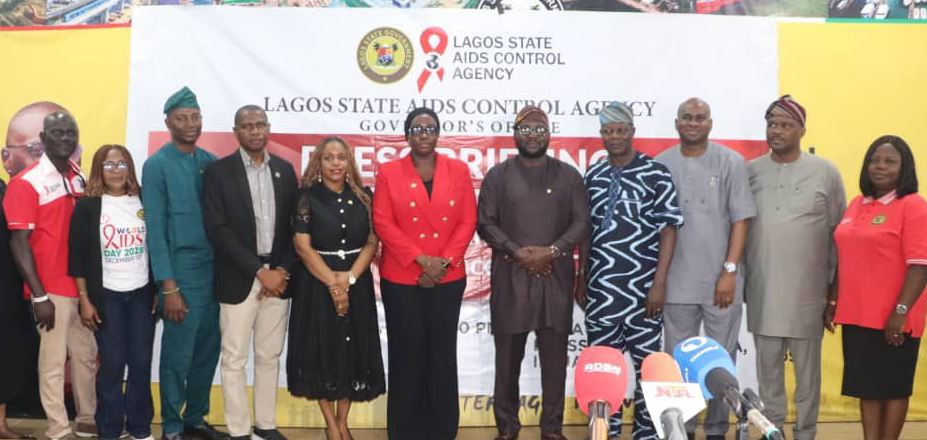

By Adebola Isimijola, Lagos
The Lagos State Government on Thursday dismissed reports suggesting that the state recorded the highest number of new HIV infections in Nigeria in 2025, describing the claim as misleading and assuring residents that there is no cause for panic.
The government clarified that the widely circulated figure of 10,430 does not represent new infections recorded in 2025 but refers to HIV-positive cases diagnosed from a 2018 survey, stressing that Lagos remains on course in its efforts to control the epidemic through expanded testing, treatment and prevention programmes.
The clarification was given by the Chief Executive Officer of the Lagos State AIDS Control Agency (LSACA), Dr. Folakemi Animashaun, during a press conference held at the Bagauda Kaltho Press Centre, Alausa, Ikeja.
According to Animashaun, recent media reports misinterpreted programme data by equating newly diagnosed HIV-positive cases with new infections, two indicators she said are scientifically different.
She explained that newly diagnosed cases include persons who may have contracted the virus years earlier but were only recently tested, as well as patients referred from other states and those who travelled to Lagos to access healthcare services.
“A newly diagnosed HIV-positive case simply means an individual was confirmed HIV-positive during the reporting period. These include persons who may have acquired HIV several years earlier but were only recently tested,” she said.

Animashaun warned that misrepresenting public health data could fuel unnecessary fear, deepen stigma and discrimination against people living with HIV, discourage testing and ultimately undermine public health interventions.
She noted that Lagos, being Nigeria’s most populous state, commercial hub and one of the country’s biggest healthcare referral centres, naturally records high volumes of HIV testing, diagnosis and treatment, adding that increased case detection reflects improved surveillance and wider access to healthcare rather than a worsening epidemic.
The LSACA boss disclosed that Lagos conducted 504,800 HIV tests in 2025, identifying 11,940 HIV-positive cases with a positivity rate of 2.4 per cent.
She added that in the first quarter of 2026 alone, the state carried out 179,229 HIV tests, identifying 3,390 HIV-positive cases while the positivity rate declined further to 1.9 per cent.
“The declining positivity rate, despite expanded testing, is a significant epidemiological indicator that reflects improving epidemic control,” she stated.
Animashaun further revealed that 147,904 people were receiving antiretroviral therapy across Lagos as of 2025, with 97 per cent achieving viral suppression, describing the figure as a major public health milestone.

She also said the state’s Early Infant Diagnosis positivity rate declined from 5.1 per cent in 2020 to 1.5 per cent in 2025, reflecting sustained progress in preventing mother-to-child transmission of HIV.
To consolidate the gains, she said the state had commenced the implementation of a comprehensive HIV Response Acceleration Plan for July to September 2026, aimed at expanding HIV testing, strengthening treatment linkage and retention, improving service quality, scaling up community-based prevention and enhancing data quality across the 20 Local Government Areas and 37 Local Council Development Areas.
Animashaun disclosed that the Lagos State Government had also directly procured antiretroviral medicines to guarantee uninterrupted treatment services, with the first consignment expected to arrive before the end of August.
According to her, the initiative makes Lagos the first sub-national government in Nigeria to independently procure antiretroviral medicines for people living with HIV, reducing dependence on donor support while strengthening long-term healthcare sustainability.
She reaffirmed that HIV remains preventable and manageable, urging residents to know their HIV status, access available prevention, testing and treatment services, rely only on verified public health information and reject all forms of stigma and discrimination.
Earlier, the Special Adviser to the Governor on Media and Publicity, Mr. Gboyega Akosile, said the briefing was convened to correct misinformation circulating in sections of the traditional and digital media regarding HIV statistics in Lagos.
He noted that the administration of Governor Babajide Sanwo-Olu had continued to invest heavily in healthcare infrastructure and public health programmes, including HIV prevention, treatment and care, and urged journalists to disseminate only verified information to prevent unnecessary public anxiety.
Discover more from SAFARI XPRESS NEWS
Subscribe to get the latest posts sent to your email.








#lasg
… reposted this!