

By Adebola Muili
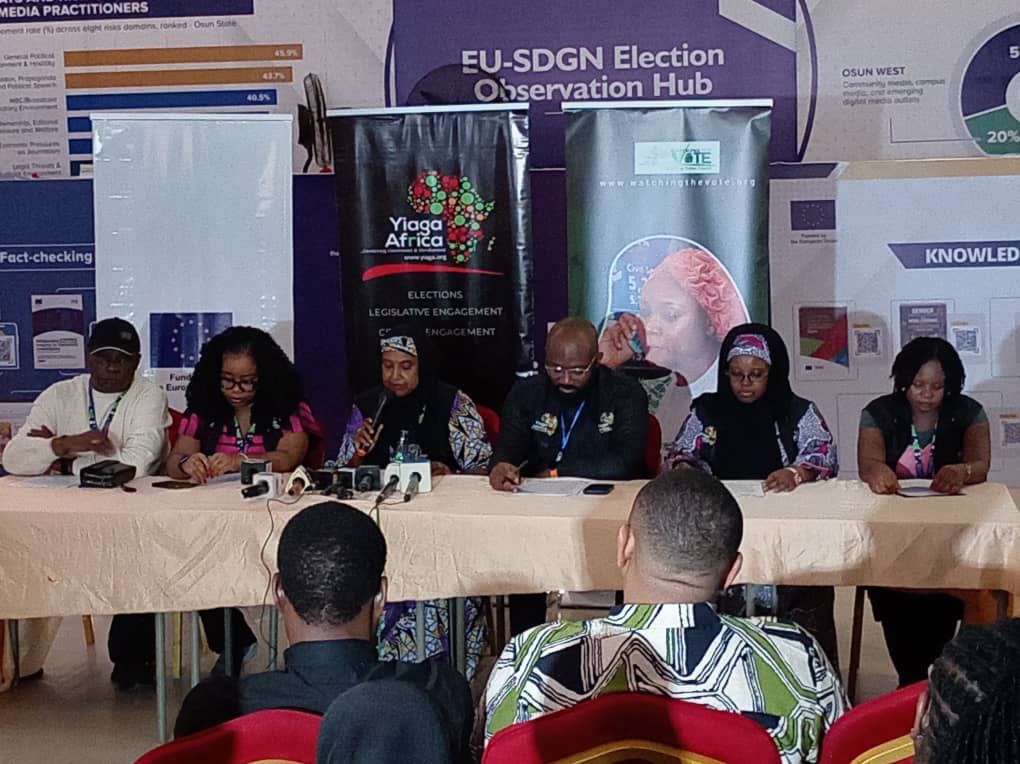
Yiaga Africa has raised concerns over possible security threats, technical challenges with the Bimodal Voter Accreditation System (BVAS) and logistical pressures ahead of Saturday’s governorship election in Osun State.
The civil society organisation, in a briefing yesterday, said preparations by the Independent National Electoral Commission (INEC) were broadly on track, but warned that the true test would be the electoral body’s ability to deliver a peaceful, transparent and credible election on polling day.
More than 2.3 million registered voters are expected to participate in the election across 3,763 polling units in the 30 local government areas of the state, with INEC planning to deploy 4,427 BVAS devices, including backup machines.
Yiaga Africa said its observation of INEC’s mock accreditation exercise revealed instances where BVAS devices temporarily failed to recognise fingerprints, facial features and some older Permanent Voter Cards (PVCs).
According to the organisation, INEC attributed some facial-recognition failures to compatibility thresholds affecting older voter records, particularly those that had not been revalidated.
It urged INEC to ensure that the challenges identified during the mock exercise had been resolved before the election, warning that widespread technical failures could cause delays, frustration and disputes at polling units.
The organisation also expressed concern over the security situation, citing the attack on a PVC collection centre at Oyinlola DC Primary School, Okuku, in Odo-Otin Local Government Area, where suspected hoodlums reportedly carted away several packs of PVCs.
It further cited incidents in Osogbo and disputes linked to motor parks, as well as inflammatory political rhetoric and hate speech, as potential threats to a peaceful election.
Yiaga Africa called on security agencies to investigate electoral offences without regard to the status or political affiliation of suspects.

“Selective enforcement will only reinforce perceptions of institutional bias and further erode confidence in election security,” it warned.
Another issue highlighted by the organisation is the late inclusion of the Social Democratic Party (SDP) candidate, Dr Francis Olugbenga Ajala, and his running mate, Faseke Babajimi Oladipo, following a Federal High Court order.
Yiaga Africa said the court order compelled INEC to reprint ballot papers and result sheets to accommodate the SDP, with the revised materials expected in Osun yesterday, leaving the commission limited time to sort and distribute them ahead of Saturday’s poll.
While acknowledging that the court order must be obeyed, the organisation warned that late changes to election materials could place additional pressure on INEC’s logistics and affect the timely commencement of voting.
It also raised concerns over alleged vote-buying, saying some political actors had distributed cash and gifts during the campaign under the guise of social interventions or charitable activities.
The organisation urged political parties and candidates to honour the peace agreement they signed and prevent their supporters from engaging in violence and voter inducement.
On voter education, Yiaga Africa said activities had increased since July, involving INEC, civil society organisations and the National Orientation Agency.
It, however, noted that targeted voter education programmes for women were observed in only two LGAs, while youth-focused activities were recorded in three. Activities targeting persons with disabilities were observed in about half of the state’s LGAs.
The organisation warned that inadequate voter education, coupled with violence, inflammatory rhetoric and distrust, could discourage some eligible voters from turning out.
Meanwhile, Yiaga Africa said the election would provide an important test of the Electoral Act 2026, particularly provisions requiring polling-unit results to be electronically transmitted to INEC’s IReV portal after the prescribed result form has been completed.
It noted that the physical Form EC8A remains the primary source for collation where electronic transmission fails because of communication problems.
Under its Watching The Vote programme, Yiaga Africa said it would deploy 300 stationary observers to selected polling units, supported by 32 mobile observers covering all 30 LGAs.
The organisation said its Process and Results Verification for Transparency methodology would monitor accreditation, voting and counting and compare its findings with the official result declared by INEC.
It will also deploy its Election Result Analysis Dashboard (ERAD 2.0) to monitor polling-unit result sheets uploaded to the IReV platform.
Yiaga Africa stressed that ERAD 2.0 would not declare the winner but would assess whether result sheets were uploaded, accessible and complete, and whether the documents published corresponded with events at polling units.
It called on INEC to resolve outstanding BVAS challenges and activate contingency plans for the timely distribution of ballot papers and result sheets.
The organisation also demanded access to collation centres for accredited observers, party agents and journalists, while urging security agencies to remain politically neutral and respect the rights of voters and election stakeholders.
It further called for closer coordination among security agencies, the Economic and Financial Crimes Commission (EFCC) and the Independent Corrupt Practices and Other Related Offences Commission (ICPC) to tackle vote-buying and other electoral offences.
Yiaga Africa said the success of Saturday’s election would ultimately depend not on the number of preparations completed by INEC, but on whether the commission and other institutions could deliver a peaceful, transparent and credible process under pressure.
Discover more from SAFARI XPRESS NEWS
Subscribe to get the latest posts sent to your email.







Leave a Reply