

By Adebola Isimijola, Lagos
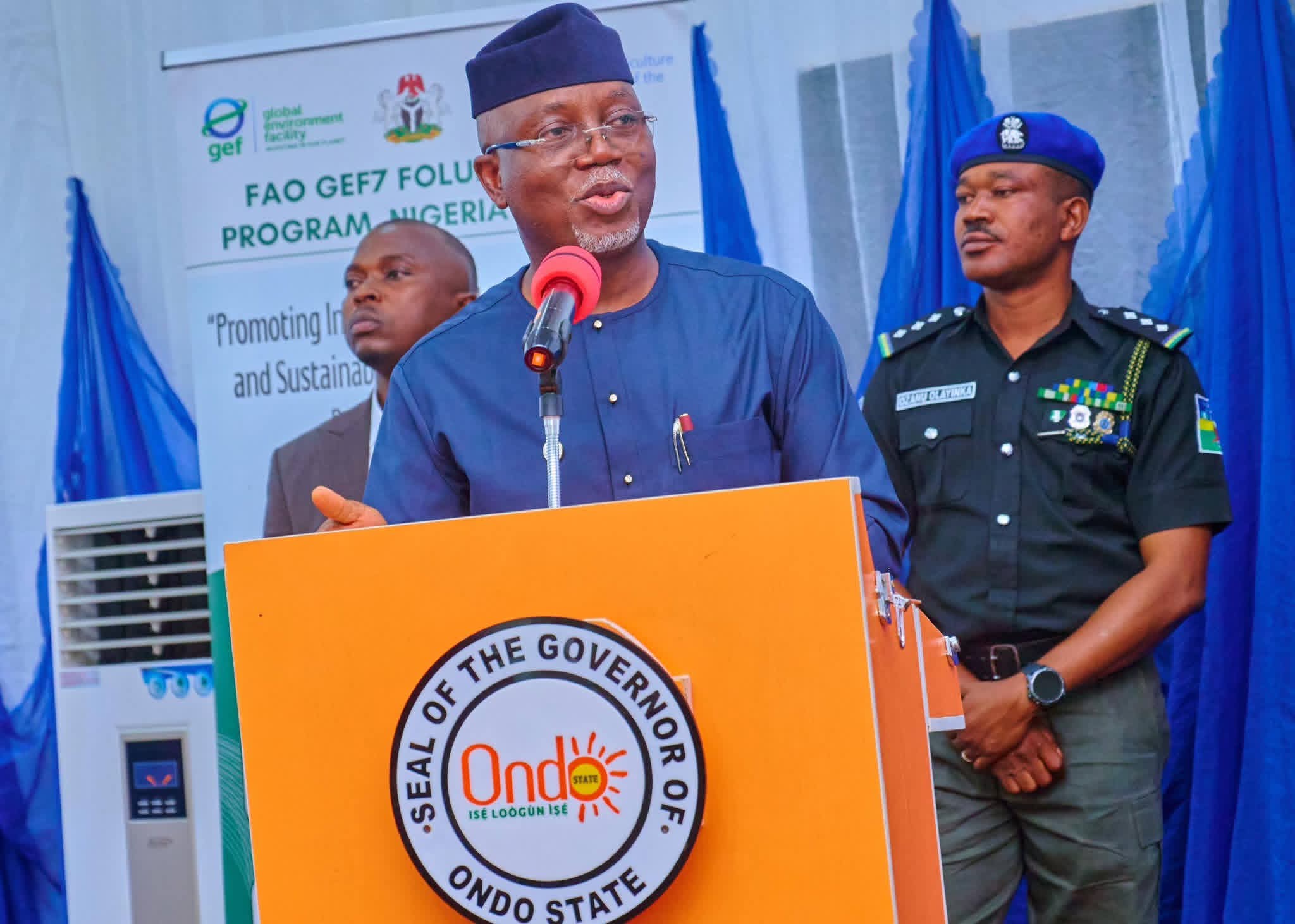
Governor of Ondo State, Lucky Orimisan Aiyedatiwa, says his administration has intensified efforts to combat deforestation and reposition the state’s cocoa sector in line with international standards on sustainable agricultural production and export compliance.
The governor stated this on Tuesday at the opening of the 2nd FAO Participatory Informed Learning Approach Multi-Stakeholders Workshop in Akure, according to a statement issued by his Chief Press Secretary, Prince Ebenezer Adeniyan.
Aiyedatiwa disclosed that the state government had inaugurated a Strategic Committee on European Union Deforestation-Free Regulation compliance to align Ondo’s cocoa industry with global standards on deforestation-free cocoa production, agroforestry and restoration of degraded forests.
He added that the government had also constituted a forest management committee to monitor activities within forest reserves and strengthen conservation efforts across the state.
According to the governor, the FAO GEF-7 Food Systems, Land Use and Restoration Impact Programme has continued to contribute significantly to sustainable agricultural practices and environmental protection in the state.
He said the project was being implemented across eight local government areas — Akure South, Idanre, Ondo West, Ile-Oluji/Okeigbo, Owo, Odigbo, Okitipupa and Irele.
Aiyedatiwa revealed that about 14,000 smallholder cocoa and oil palm farmers had already been profiled under the pilot phase of the programme.

He commended the Food and Agriculture Organization of the United Nations for supporting efforts aimed at transforming cocoa and oil palm production systems in the Niger Delta towards sustainability and resilience.
The governor acknowledged the supply of Geographic Information System equipment to Ondo State for the establishment of a GIS Laboratory in the state REDD+ Unit, noting that the facility had enhanced geospatial analysis and mapping activities for effective forest landscape management.
He further stated that the project had supported the provision of agroforestry and timber seedlings for farmers and members of the Ondo State Timber Trade Organisation to facilitate restoration of degraded forest sites.
According to him, agricultural extension officers and farmers had also been trained on climate-smart agriculture, cocoa and oil palm production, agroforestry practices, polygon mapping for European Union Deforestation Regulation compliance, integrated land management and customary land titling.
Aiyedatiwa stressed the need for stakeholders to embrace integrated landscape management and sustainable food systems capable of ensuring food security and improved livelihoods for farmers.

He assured that the state government would increase its counterpart funding support for the FAO GEF-7 project to guarantee improved performance and successful implementation across the state.
Earlier, the National Coordinator of FAO in Nigeria, Dr. Nifesimi Ogunkua, called for stronger collaboration among stakeholders to promote sustainable land use, agroforestry and improved access to international markets for cocoa and oil palm farmers in Ondo State.
Ogunkua explained that FAO remained responsible for the technical quality and overall delivery of the project while working with national institutions to ensure sustainable impacts.
She noted that the Forestry Research Institute of Nigeria serves as the executive partner through the National Project Management Unit and State Implementation Unit under the global programme being implemented across Africa, Asia and Latin America.
According to her, the programme seeks to transform food systems through sustainable agriculture, reduction of deforestation and land degradation, ecosystem restoration, improved livelihoods and environmental governance.
“Ondo State occupies a strategic position in Nigeria’s cocoa landscape and can emerge as a leading model for sustainable and climate-resilient cocoa production if stronger land use planning, agroforestry systems and forest conservation are prioritised,” she said.

Ogunkua warned that increased cocoa and oil palm production would amount to little if farmers could not access premium international markets through traceability and certification systems.
In his welcome address, the Commissioner for Agriculture and Forestry, Engr. Leye Akinola, said the workshop focused on integrated landscape management plans, integrated land use planning, tenure and customary land titling, governance frameworks, agroecological transition pathways, responsible standards and certification, as well as participatory spatial planning.
He explained that the workshop was designed to strengthen stakeholders’ alignment, enhance institutional collaboration and identify practical measures to support sustainable land use, agricultural food systems and effective environmental management.
Akinola commended the Federal Government, the Federal Ministry of Agriculture and Food Security, the Federal Ministry of Environment, the Forestry Research Institute of Nigeria, the National Project Management Unit and the State Project Implementation Unit for supporting the successful implementation of the project in Ondo State since March 2024.
Also speaking, the Chairman of ALGON in Ondo State, Gbenga Fasua, assured that the eight benefiting local governments would support and sustain the project.
Dignitaries at the event included the Deputy Governor of Ondo State, Dr. Olayide Adelami, Chief of Staff, Prince Segun Omojuwa, local government chairmen and traditional rulers.
Discover more from SAFARI XPRESS NEWS
Subscribe to get the latest posts sent to your email.












Leave a Reply