

By Adebola Muili
The Federal Government has said the economic reforms introduced by President Bola Ahmed Tinubu’s administration have generated ₦20.4 trillion in incremental resources for the Federal Government between June 2023 and December 2025.
The government said the resources were mobilised through ₦15.8 trillion in savings from fuel subsidy removal, ₦3.1 trillion in incremental independent revenue and ₦11.9 trillion in incremental borrowing.
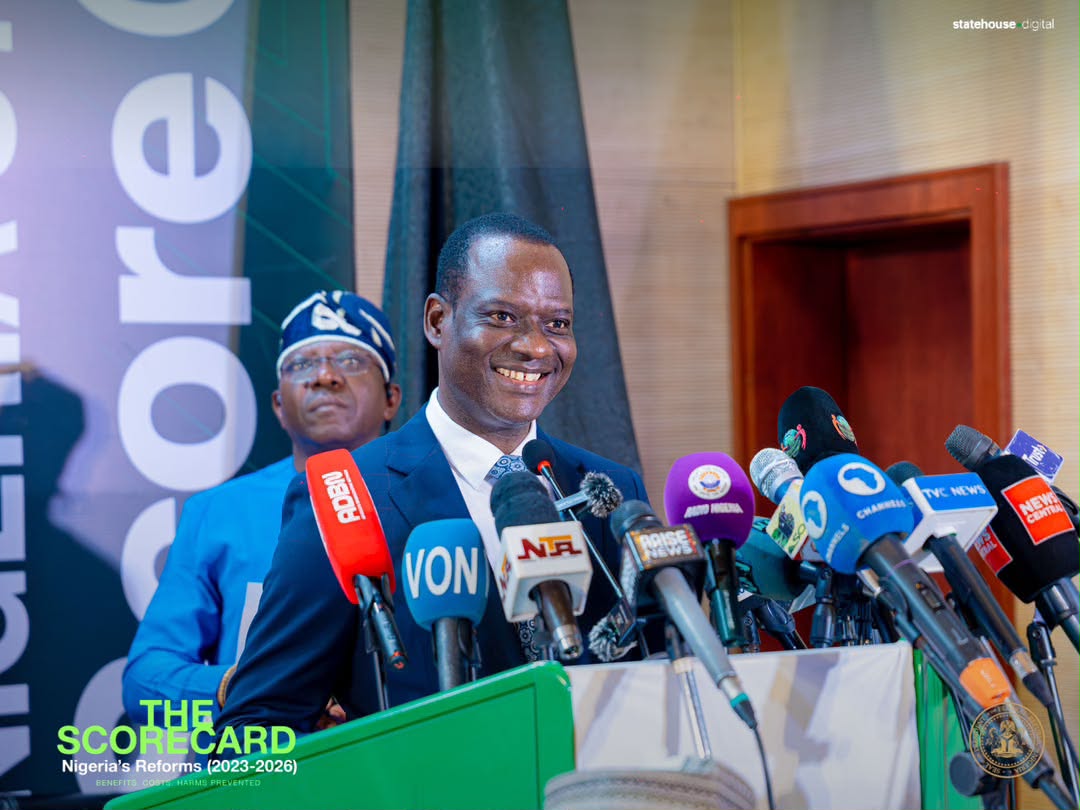
It disclosed this on Wednesday, August 19, 2026, during the presentation of a three-year economic reform scorecard assessing the impact of the administration’s policies since May 2023.
According to the scorecard, ₦5.4 trillion of the ₦15.8 trillion subsidy savings accrued to the Federal Government, while ₦10.4 trillion was shared among states and local governments.
The government said the reforms created fiscal space to support increased expenditure while reducing dependence on excessive Ways and Means financing by the Central Bank of Nigeria.
It explained that the Federal Government’s ₦20.4 trillion in incremental resources partly funded ₦30.64 trillion in incremental expenditure during the period.
Of the expenditure, ₦9.39 trillion went into wage adjustments, minimum wage increases and allowances for public servants; ₦9.37 trillion was spent on external debt servicing arising from exchange rate depreciation, while ₦6.5 trillion went into strategic infrastructure.
“Every naira of this is accounted for, and the breakdown is in the scorecard we are releasing today,” the government said.
It stressed that the reforms were not primarily introduced to generate revenue but to tackle structural distortions and corruption associated with the former fuel subsidy regime and multiple foreign exchange rates.
The government said 58 per cent of the ₦20.4 trillion incremental resources came from borrowing, 27 per cent from subsidy savings and 15 per cent from other revenue.
It added that the new resources funded about two-thirds of the ₦30.64 trillion incremental expenditure, while the remaining one-third, estimated at about ₦10 trillion, came from the existing revenue base.
According to the government, the assessment was based on a scorecard containing 25 indicators across five areas: fiscal sustainability, external stability, investment climate, social impact, and growth and productivity.
The scorecard compared Nigeria’s economic position in May 2023 with the latest verified data available as of mid-2026, alongside a “no-reform” projection estimating where the economy could have been if the pre-2023 fuel subsidy regime, multiple exchange rates and unchecked Ways and Means financing had continued.
On the impact of the reforms on citizens, the government said salaries and pensions were now being paid on time, while longstanding pension arrears had been settled.
It also highlighted the increase in the minimum wage from ₦30,000 to ₦70,000 and said the National Education Loan Fund (NELFUND) had supported more than 1.5 million students.
Other measures cited included cash transfers to millions of households, subsidised mortgages, agricultural support and tax reforms designed to exempt low-income earners and small businesses from tax.
The government further claimed that the reforms had strengthened the finances of state governments, noting that 27 states could not reliably pay salaries in May 2023, compared with none currently facing the same situation.
It estimated that, without the reforms, at least 30 states could have been unable to meet their salary obligations by 2026.
On the foreign exchange market, the government said the premium between the official and parallel market rates, which was once above 60 per cent, had fallen to below five per cent.
It also said the ₦30 trillion legacy Ways and Means stock had been curtailed rather than allowed to double under the pre-reform trajectory.
However, the government acknowledged that the reforms had imposed significant costs on Nigerians.
“The Monetary Policy Rate has risen from 18.5 per cent to 26.5 per cent; we record that plainly as the cost of stabilisation, not a hidden win,” it said.
It noted that petrol prices had risen from about ₦185 per litre before the reforms to between ₦1,100 and ₦1,400, describing the increase as “a major, felt cost.”
On food and household welfare, the government admitted that recovery remained a work in progress, although food inflation had declined from 24.82 per cent to 17.52 per cent as of June 2026.
“Poverty and household welfare recovery is still classified in our own scorecard as unfinished business, not a victory lap,” it said.
The government therefore urged Nigerians to support positive policies while encouraging constructive criticism and reliance on verified information.
It also called on citizens to seek facts and a proper understanding of government policies rather than relying on misinformation, populist narratives and sensational headlines.
Discover more from SAFARI XPRESS NEWS
Subscribe to get the latest posts sent to your email.








Leave a Reply