

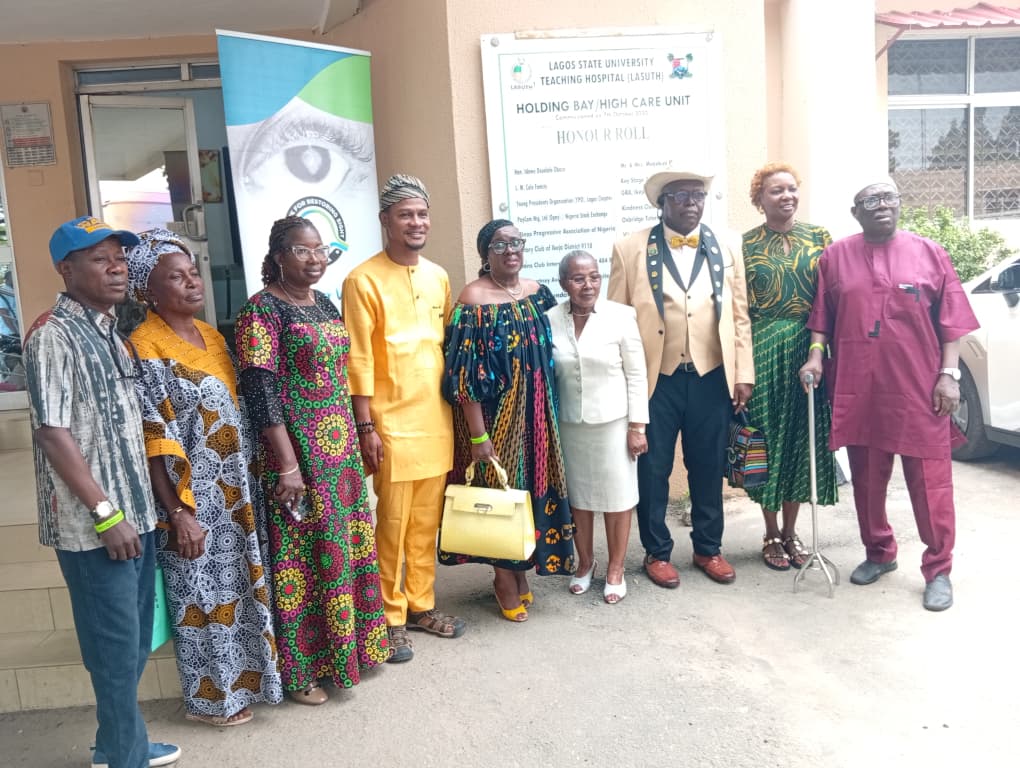
By Adebola Muili
More than 200 Nigerians suffering from corneal blindness are currently on the waiting list for corneal transplants, the Eye Bank for Restoring Sight in Nigeria has disclosed, as stakeholders intensify advocacy for increased eye donation across the country.
The Medical Director of the Eye Bank, Dr Mosunmade Fadarin, disclosed this in Lagos on Thursday, August 20, 2026, during the unveiling of veteran actress, Ms Joke Silva, as the organisation’s brand ambassador.
Fadarin said the development underscored the urgent need for Nigerians to embrace cornea donation after death, noting that donated corneas could restore sight to people suffering from corneal opacity, one of the reversible causes of blindness.
She explained that the Eye Bank was established to promote the donation, collection, processing, storage and distribution of transplantable corneas to qualified surgeons, stressing that the organisation does not perform transplant surgeries itself.
According to her, the Eye Bank facilitates access to donor corneas and supports the transplantation process, while also promoting medical education, research and public awareness on eye donation.
Fadarin said one of the major misconceptions discouraging Nigerians from donating their corneas was the belief that the entire eye would be removed after death.
“We are not taking out the whole eye,” she said, explaining that the cornea is the clear front portion of the eye that can be transplanted to restore sight in suitable patients.
She said cultural beliefs, misconceptions and fear of stigma remained major barriers to eye donation, adding that the Eye Bank had taken its awareness campaign to churches, clubs, Rotary and Lions clubs, private organisations and communities.

Fadarin noted that the Eye Bank was established as a joint project of the Ophthalmological Society of Nigeria and the Federal Nigeria Society for the Blind, with a core mandate to harvest, process and distribute donor eye tissue to corneal transplant surgeons.
She said the shortage of donor corneas remained critical, recalling cases of people, including children, who had lost their sight from conditions that could potentially have been treated through corneal transplantation if donor tissues were available.
According to her, the Eye Bank was also working with local and international eye-banking centres to strengthen its capacity and improve access to corneal transplantation in Nigeria.
Fadarin appealed to Nigerians not to allow cultural fears surrounding death to prevent them from giving others the opportunity to regain their sight.
Her appeal was reinforced by the testimony of a corneal transplant recipient, Pa Oguntibeju, who narrated how the procedure restored his independence after years of visual impairment.
Oguntibeju said a serious eye infection had left him unable to perform basic activities without assistance before he received a corneal transplant in 2022.

He said he regained his sight almost immediately after the procedure.
“In fact, the same day they did it was the day I started seeing,” he said.
Oguntibeju recalled that before the transplant, he could neither read nor move around independently, adding that he required assistance to eat and use the toilet.
“But immediately they did the transplant, I can even read my Bible. I can eat myself… then go to the toilet myself. Nobody is assisting me to do everything,” he said.
He expressed gratitude to the medical team and the Eye Bank, saying a stronger corneal banking system in Nigeria would reduce the need for Nigerians to seek treatment abroad.
Also speaking, Lion Kunle Shodipo, brother of a deceased cornea donor, narrated how his family eventually honoured his late brother’s wish to donate his cornea after death.
Shodipo said his brother had indicated in his will that his cornea should be donated, but the family initially had to overcome emotional and cultural concerns before giving its consent.
He said the family became more comfortable with the decision after learning that the procedure involved the removal of the cornea and not the entire eyeball.
According to him, the experience changed the family’s perception of organ donation and encouraged others to consider the practice.
Shodipo said his late brother’s donation demonstrated that a person could continue to contribute to humanity even after death.
He urged Nigerians to support cornea donation, adding that he would have no difficulty publicly acknowledging it if he ever became a recipient.
In a related testimony, Vice-Chairman of the Eye Bank, Mrs Fola Akande, disclosed that she was also a cornea donor and the daughter of a deceased donor.
Akande said her 83-year-old mother died suddenly on September 24, 2012, after being active and apparently well shortly before her death.
She said her father, an ophthalmologist and one of the founding fathers of the Eye Bank, immediately contacted the appropriate medical personnel, leading to the harvesting of her mother’s corneas within the required period.
According to her, the donated corneas were subsequently used to restore the sight of recipients.
Akande said the experience convinced members of her family to become donors.

“Because of that, all of us in the family, we are all donors, and it’s important to give, so that someone else can give,” she said.
Meanwhile, the newly unveiled brand ambassador, Joke Silva, pledged to use her influence to promote awareness and advocacy for cornea donation.
Silva, who spoke about her family’s longstanding connection with the medical profession, said her involvement was informed by her belief that people outside the medical profession could also contribute meaningfully to healthcare.
She stressed the need for Nigerians to develop solutions to challenges within the country rather than depending excessively on foreign assistance.
“Advocacy, it’s so important that Nigeria does what Nigeria can do for Nigeria. We need to stop depending on the rest of the world for what we can do for ourselves,” Silva said.
She described cornea donation as a unique opportunity to contribute to humanity without imposing a financial burden on the donor, noting that donating one’s corneas after death could enable another person to regain sight and live a productive life.
Silva pledged to play her part in creating awareness and encouraging Nigerians to support the Eye Bank’s mission.
Also speaking, Chairman, Board of Governors of the Eye Bank for Restoring Sight in Nigeria, Dr Festus Oshoba, said the organisation was collaborating with governmental and non-governmental bodies to advance its objectives.
Oshoba said the campaign was aimed at creating awareness that people could continue to contribute to society even after death by donating body parts that could be useful to others.
“We need to talk to our people and let them know that somebody that you know may be the beneficiary of that organ that you are donating,” he said.
He said the organisation’s motto, “Never ignore restorable blindness,” captured its commitment to ensuring that people whose blindness could be reversed through corneal transplantation were not abandoned.
Representing the Chief Medical Director of the Lagos State University Teaching Hospital, Prof Adetokunbo Fabamwo, the Deputy Chairman, Medical Advisory Committee, Dr Bamidele Ayodele, described healthcare as a collective responsibility.
“Health is a collective responsibility; everyone has to contribute their own quota,” Ayodele said.
The Eye Bank officials said increased public participation in cornea donation remained essential to reducing the number of Nigerians living with avoidable or reversible blindness and ensuring that more patients on the waiting list could regain their sight.
Discover more from SAFARI XPRESS NEWS
Subscribe to get the latest posts sent to your email.






Leave a Reply