

By Adebola Muili
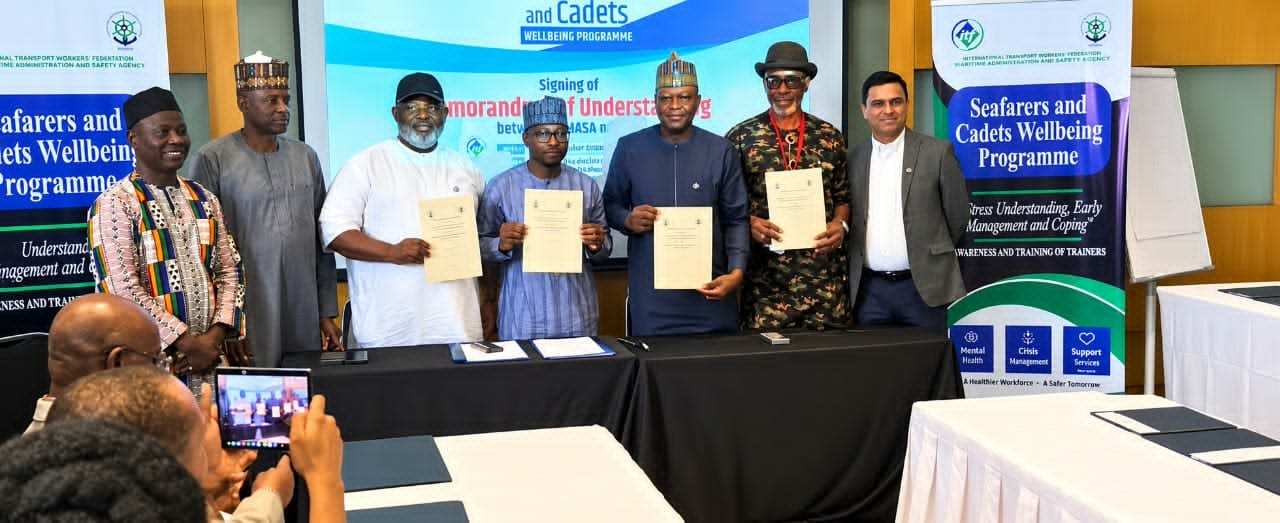
The Nigerian Maritime Administration and Safety Agency (NIMASA) and the International Transport Workers’ Federation (ITF) have signed an agreement to strengthen mental health support and improve the welfare of Nigerian seafarers and cadets, in what the ITF describes as the first partnership of its kind with a country in Africa.
The agreement, formalised through a Memorandum of Understanding (MoU), is aimed at promoting mental health awareness, professional training and capacity building, as well as integrating wellbeing education into maritime training curricula to better prepare seafarers for the challenges of life at sea.
This was contained in a statement made available to journalists on Monday by NIMASA’s Deputy Director and Head of Public Relations, Osagie Edward, following a three-day Seafarers’ and Cadets’ Wellbeing Awareness and Train the Trainers Programme organised by the agency in collaboration with the ITF.
Speaking at the programme, NIMASA Director-General, Dr Dayo Mobereola, said the partnership would strengthen efforts to identify, manage and address mental health challenges among seafarers through structured training and improved institutional support.
Mobereola, represented by the Executive Director, Maritime Labour and Cabotage Services, Mr Jibril Abba, who endorsed the MoU on behalf of NIMASA, said the agreement would equip maritime training institutions, agency officers and union representatives with the skills required to recognise signs of psychological distress and provide appropriate support, including psychological first aid where necessary.
He said the agency was committed to making seafarer wellbeing a permanent component of preparations for life at sea, stressing that the mental health of maritime workers was essential to safe shipping.
According to him, seafarers face several psychological challenges arising from the demanding nature of their work, including stress, anxiety, depression and burnout, which require early identification and appropriate management.
To underscore the scale of the challenge, Mobereola cited a 2019 study commissioned by the ITF in collaboration with Yale University, which found that one in four seafarers surveyed showed signs of depression, while approximately one in six exhibited signs of anxiety.
The findings, he noted, highlighted the need for sustained attention to the psychological wellbeing of seafarers, particularly those who work for extended periods in difficult conditions and remain separated from their families and loved ones.
He said the partnership would provide an avenue for strengthening the capacity of maritime stakeholders to recognise mental health challenges and respond effectively, while promoting a culture in which seafarers’ welfare receives greater institutional attention.
The ITF Africa Regional Secretary, Mr Safiyanu Dauda Mohammed, who signed the agreement on behalf of the federation, described the MoU as a significant development for seafarer welfare in Africa.
Mohammed said the agreement was the first of its kind that the federation had entered into with a country on the continent, adding that Nigeria had taken the lead in establishing a formal partnership focused on the wellbeing of maritime workers.
“It is very exciting for me because it is the first in Africa, and we are starting with Nigeria,” he said.
He stressed that seafarers were critical workers in the maritime sector and that their mental health and general welfare must be prioritised to reduce the effects of anxiety and depression.
According to him, addressing these challenges was important not only for the welfare of individual workers but also for the effective functioning of the maritime industry.
Also speaking, the President-General of the Maritime Workers Union of Nigeria, Comrade Francis Bunu, commended the initiative, saying seafarers needed to be mentally sound to carry out their duties effectively.
“We need seafarers to be mentally sound while doing their job, and that is why today is a very significant day for the seafarer in Nigeria,” Bunu said.
The three-day programme, themed “Stress: Understanding, Early Management and Coping,” was designed to build the capacity of participants to identify stress, understand its effects and develop appropriate strategies for managing psychological challenges among seafarers and cadets.
The training brought together maritime stakeholders to strengthen awareness and promote practical approaches to mental health support within the sector.
Seafarers often work in demanding environments and spend long periods away from home, circumstances that can expose them to stress and other psychological difficulties. The initiative is therefore expected to encourage earlier recognition of such challenges and improve access to appropriate support.
Other participants at the programme included the National President of the Nigerian Merchant Navy Officers and Water Transport Senior Staff Association, Chief Engineer Bob Joseph Yousou; ITF Wellbeing Coordinator, Dr Asif Altaf; and ITF Inspector, Mr Hamani Amadou, alongside other industry stakeholders.
The partnership reinforces NIMASA and the ITF’s commitment to improving seafarer welfare through sustained training, institutional cooperation and stronger mental health support, with the aim of promoting healthier workers and safer shipping operations.
Discover more from SAFARI XPRESS NEWS
Subscribe to get the latest posts sent to your email.








Leave a Reply