

By Adebola Muili
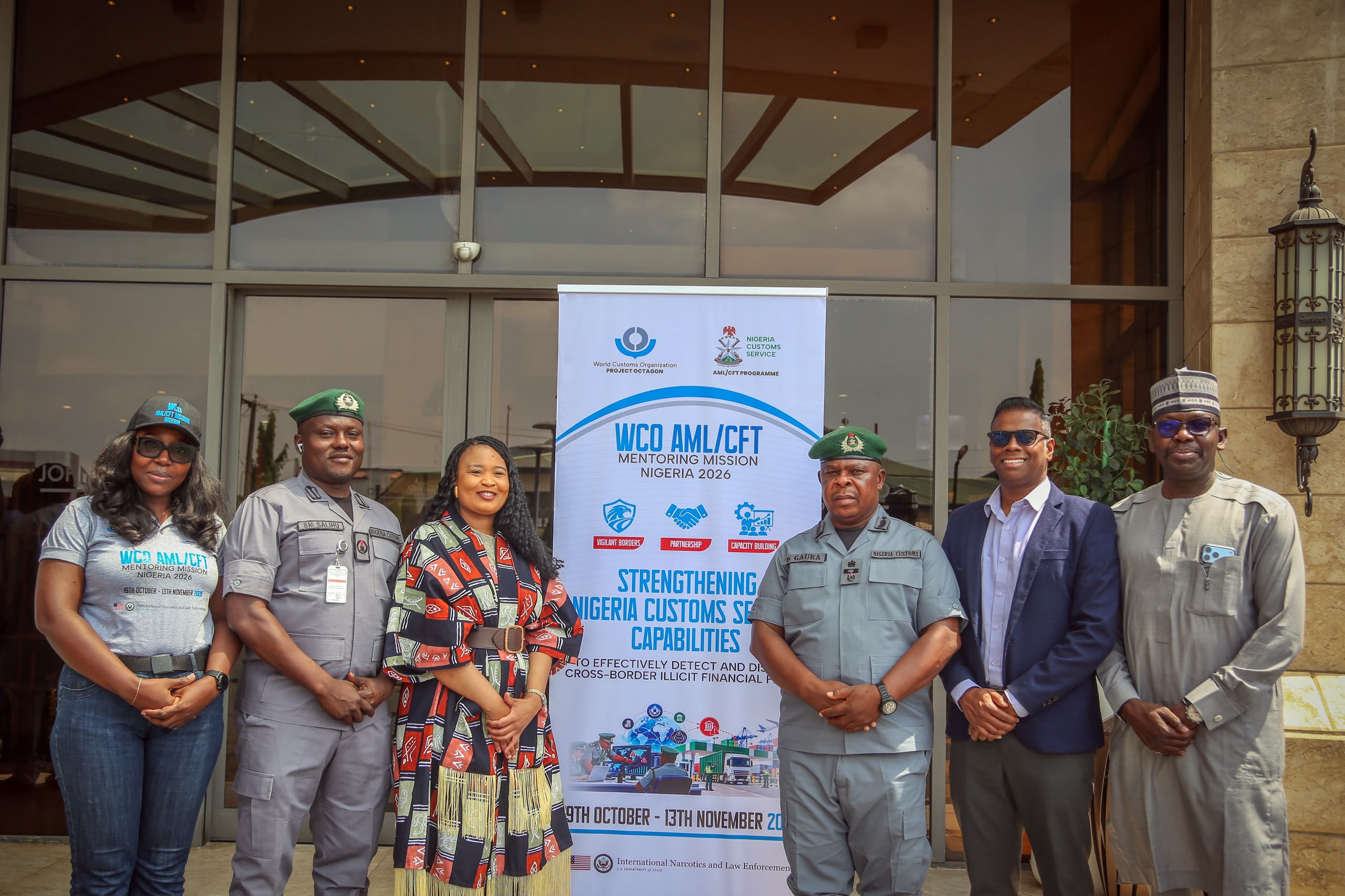
The Nigeria Customs Service (NCS) is strengthening its capacity to track suspicious cross-border financial movements, including transactions involving gold, gemstones and questionable trade invoices, as part of efforts to combat money laundering and the financing of terrorism.
The initiative, undertaken in collaboration with the World Customs Organisation (WCO), also seeks to improve intelligence sharing and operational cooperation among security and law enforcement agencies in detecting financial crimes that exploit international trade and cross-border movements.
A total of 120 personnel drawn from six government agencies participated in the capacity-building exercise, with 60 participants each attending sessions in Abuja and Lagos. The participating agencies included the NCS, Nigeria Immigration Service (NIS), Economic and Financial Crimes Commission (EFCC), National Drug Law Enforcement Agency (NDLEA), Nigeria Police Force (NPF) and Nigeria Financial Intelligence Unit (NFIU).

The training, which commenced on November 2, 2026, at Johnwood Hotel, Wuse 2, Abuja, ended on November 12 in Lagos, marking the completion of the capacity-building phase of the WCO Anti-Money Laundering and Countering the Financing of Terrorism (AML/CFT) Mentoring Mission to Nigeria.
Speaking at the Abuja session, the Acting Deputy Comptroller-General of Customs in charge of Strategic Research and Policy, Nafiu Isiaku, who represented the Comptroller-General of Customs and the Service’s management, emphasised the need for stronger collaboration among relevant agencies to tackle financial crimes that transcend national boundaries.
Isiaku appreciated the WCO, particularly its AML/CFT Programme and Project OCTAGON, for supporting the development of Customs administrations. He also acknowledged the United States Department of State, through its Bureau of International Narcotics and Law Enforcement Affairs, for providing funding for the mentoring mission.

He noted that the increasing transnational nature of financial crimes required effective systems, skilled personnel and timely intelligence exchange among relevant institutions.
“These challenges transcend the specialised mandates and national borders. So addressing them effectively requires robust systems, skilled personnel, timely exchange of information, and most importantly, sustained cooperation among all relevant agencies,” he said.
As part of the mentoring mission, assessment activities examined Nigeria’s existing mechanisms for identifying financial crime risks, detecting suspicious movements, sharing intelligence and referring cases for further investigation.

Particular attention was given to suspicious cash movements, unusual trade transactions, questionable invoices and the movement of valuable commodities, including gold and gemstones, which could serve as indicators of wider financial investigations.
The subsequent training exposed participants to specialised cross-border AML/CFT modules covering financial intelligence, risk indicators, investigation techniques and information management, equipping them with practical knowledge to identify emerging threats and strengthen institutional responses.
The WCO resource persons included Felicia Ntusa, Ladassin Kitson, Mohammed Jiya, Claude Chaillou, Eduardo Escobar, Jorge Thibout and Laurent Szymkowiak, whose technical contributions provided insights into evolving financial crime trends and operational approaches to addressing them.

The WCO team also acknowledged the hospitality and cooperation of the Customs Service throughout the exercise, stressing the importance of mutual trust, experience-sharing and effective communication in strengthening inter-agency responses.
At the closing ceremony, the Deputy Comptroller-General of Customs in charge of Human Resource Development, Dow Gaura, commended participants for their commitment and active involvement throughout the mentoring exercise.
He urged them to translate the knowledge acquired into practical improvements in their respective areas of responsibility, stressing that the effectiveness of the programme would depend on its application to daily operations.

“I urge you all to put the knowledge acquired into practice and ensure that the training translates into improved performance across our operations,” Gaura said.
He also expressed the Service’s appreciation to the WCO for its initiative, technical expertise and support, while acknowledging the United States Department of State for funding the programme.
The closing ceremony featured the presentation of certificates to participants by Gaura, formally marking the completion of the capacity-building phase of the WCO AML/CFT Mentoring Mission in Nigeria.
Discover more from SAFARI XPRESS NEWS
Subscribe to get the latest posts sent to your email.


Leave a Reply