

By Adebola Muili
Nigeria’s ambition to build a $1 trillion economy may suffer a major setback unless the country urgently addresses inefficiencies in its maritime sector, particularly prolonged cargo clearance, poor port connectivity and fragmented operations among government agencies and private sector operators.
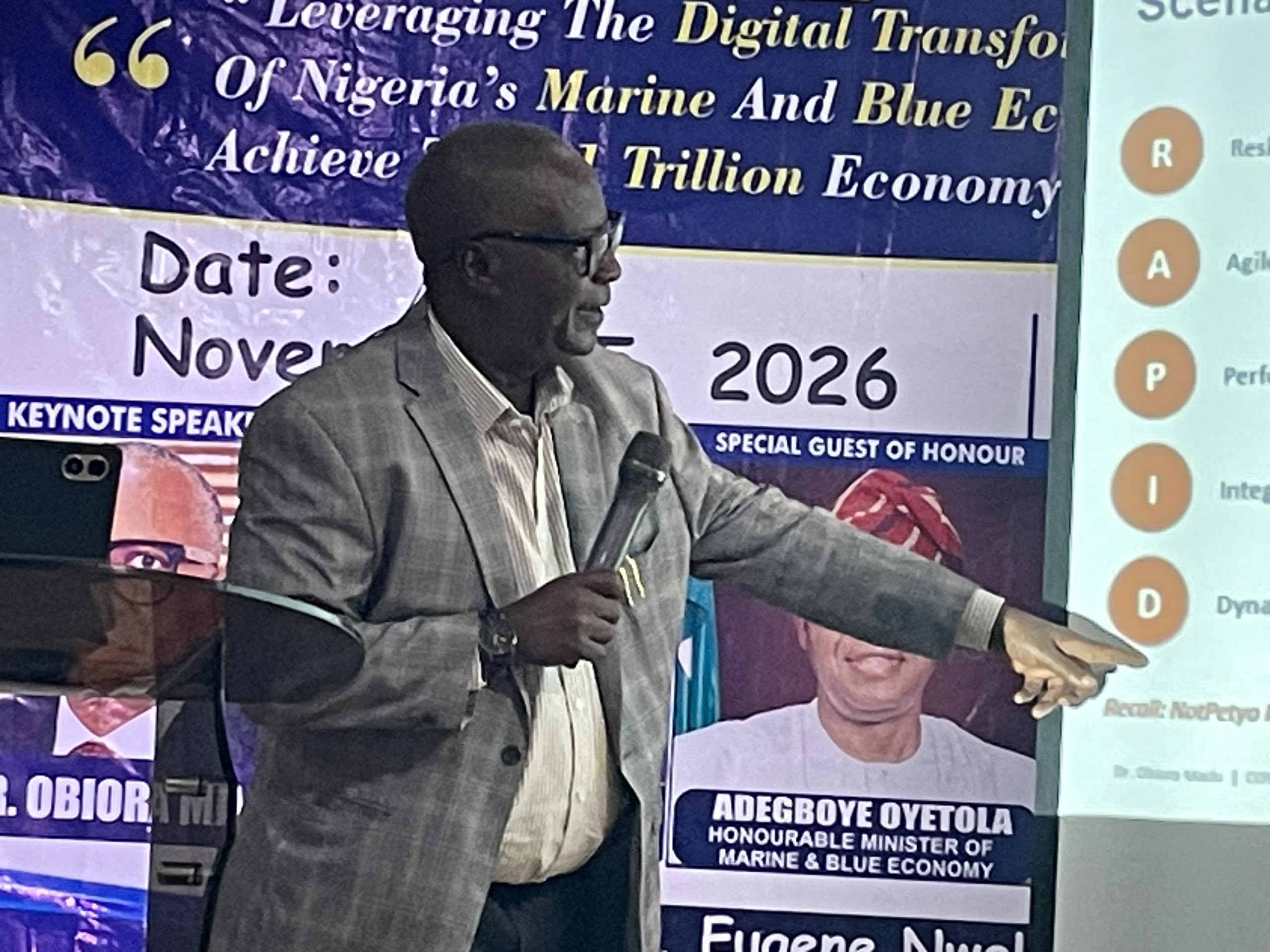
Maritime expert and keynote speaker at the 2026 Congress of Nigeria Maritime Media Professionals, Dr Obiora Madu, gave the warning while identifying inefficient logistics, inadequate indigenous shipping capacity and weak institutional coordination as major obstacles to Nigeria’s economic growth.
Madu said achieving the $1 trillion target would require sustained annual economic growth of about nine per cent, while the country must also bridge a substantial gap between its projected Gross Domestic Product of $387 billion in 2026 and the desired economic size.
He explained that Nigeria would need approximately 26.8 per cent annual growth in dollar terms to attain the target, warning that new investments in infrastructure and technology alone would not deliver the desired outcome without fundamental improvements in the way the maritime industry operates.
According to him, the country must prioritise integrated systems, competent personnel and measurable performance, noting that these remain critical weaknesses across the maritime value chain.
He observed that Nigeria had recorded significant increases in port traffic in recent years, with throughput rising from 71.2 million metric tonnes in 2023 to 103.6 million tonnes in 2024 and 123.3 million tonnes in 2025.
Ship calls also increased to about 4,477 in 2025, representing more than 20 per cent growth over the preceding year, while container traffic recorded a 25 per cent increase.
However, Madu questioned whether the rising figures reflected genuine improvements in port competitiveness, arguing that increased trade volumes had not been matched by corresponding improvements in operational efficiency.
Comparing Nigerian ports with other facilities in the region, he said vessels spent an average of five to seven days on turnaround at Apapa and Tin Can Island ports, against three to four days at Tema Port in Ghana and two to three days at Lomé Port in Togo.

He warned that the delays were making Nigerian imports more expensive and exports less competitive because shipping companies factored waiting periods into their charges, with the additional costs eventually transferred to businesses and consumers.
“Slow ports make every import dearer and every export less competitive,” he said.
The maritime expert identified the disconnect among government agencies, terminal operators, shipping companies and freight forwarders as one of the biggest problems affecting cargo movement.
He explained that the clearance of a single container involved several institutions, including the Nigeria Customs Service, Nigerian Ports Authority, shipping lines, terminal operators and freight forwarders, but their operations were not sufficiently integrated.
Citing findings attributed to the World Customs Organisation, Madu said more than 90 per cent of the total clearance time at Tin Can Island Port was spent waiting rather than undergoing active processing.
He argued that the problem could not be resolved by blaming individual officers or institutions without establishing clear responsibilities for the delays.
“Our problem is not that officers work slowly. It is that cargo waits for systems that will not talk to each other,” he said.
Madu consequently called for a coordinated operational framework that would enable relevant agencies to share information, conduct joint risk-based inspections and eliminate repetitive documentation and unnecessary physical examinations.
He stressed that the proposed National Single Window should be regarded as economic infrastructure rather than merely an information technology project.
According to him, a properly integrated Single Window would allow traders to make one electronic submission, facilitate joint inspections, eliminate repeated paperwork, integrate payments and provide end-to-end visibility of cargo movement.
He warned against the tendency to automate inefficient procedures without first redesigning them, noting that technology could only deliver meaningful results when applied to properly structured processes.
“Digitising paperwork is not transformation. Redesigning a cargo process is,” he said.
He also emphasised the importance of measuring performance, insisting that institutions must identify their responsibilities and make their operational results available for public scrutiny.
“If you can’t measure it, you can’t improve on it. If you can’t improve on it, you cannot manage it,” he said.
On Nigeria’s maritime potential, Madu lamented that the country had failed to take full advantage of its geographical position as a natural logistics hub for West and Central Africa.
He cited the performance of the Port of Lomé in Togo, which he said had developed into an important regional logistics centre through efficient operations and competent personnel.
He recalled leading postgraduate students to inspect the port, where he observed that its performance indicators compared favourably with international standards.
According to him, when he asked what accounted for the port’s performance, a representative of its management attributed the success largely to the quality of its personnel.
Madu said the experience reinforced the need for Nigeria to complement its substantial maritime infrastructure with skilled professionals and effective management.
He further expressed concern over the country’s dependence on foreign-owned vessels to transport its imports and exports, despite the volume of trade passing through Nigerian ports.
He said Nigeria must develop indigenous shipping capacity and create an environment that would enable local vessel owners to participate more effectively in international trade.
The expert also called for improved cargo evacuation by rail, stronger inland waterway connections and the development of functional inland dry ports, warning that a seaport without effective inland connectivity could become little more than a parking facility for vessels and cargo.
On the broader blue economy, Madu said Nigeria was yet to adequately exploit its marine resources, particularly fisheries, marine transportation and related industries.
He drew attention to the gap between domestic fish production and national consumption, arguing that the country continued to import substantial quantities of fish despite its extensive coastline and fishing resources.
He also warned that between 40 and 50 per cent of fish catches could be lost before reaching the market because of inadequate transportation, storage and handling facilities.
On maritime security, Madu said safer shipping corridors were essential to reducing operational costs and attracting investment, noting that piracy and armed robbery incidents in the Gulf of Guinea remained a concern.
He presented figures indicating 21 incidents in 2025, compared with 18 in 2024 and 22 in 2023, alongside 23 crew members kidnapped in four separate incidents during 2025.
He called for stronger maritime domain awareness through satellite surveillance, radar, automatic identification systems and improved intelligence gathering.
According to him, improved security would reduce the risks associated with maritime operations and help bring down insurance premiums paid by shipping companies.
To accelerate the reform process, Madu proposed reducing average cargo dwell time from 13 days to four days by 2030, while improving container handling capacity, indigenous shipping participation and digital integration across the sector.
He also advocated a 100-day implementation approach through which government agencies and industry operators could test proposed reforms, measure their outcomes and identify areas requiring further improvement.
Among the decisions he recommended were the establishment of a unified digital blue economy programme, full interoperability of the National Single Window, mobilisation of long-term investment, creation of a blue economy data and intelligence centre and deliberate development of national human capital.
He further urged maritime institutions and terminal operators to publish measurable performance indicators and accept responsibility for their contributions to delays and inefficiencies in the system.
Earlier, the Special Adviser to the Lagos State Governor on Marine and Blue Economy, Damilola Emmanuel, urged journalists to play a more active role in promoting investment and public understanding of the emerging blue economy.
Emmanuel said the media must help Nigerians understand that the economic opportunities in the country’s waterways extended beyond conventional maritime transportation, fishing and port operations to include tourism, job creation, innovation and sustainable economic development.
He identified education, advocacy, accountability, investment promotion and environmental stewardship as five critical areas through which journalists could contribute to the sector’s development.
“The waters hold the wealth, but the stories we tell can awaken a nation to its possibilities,” he said.
Also speaking, former President of the Nigeria Football Supporters Club, Dr Rafiu Ladipo, commended the organisers for providing a platform for discussions on the challenges and opportunities in the maritime industry.
Ladipo described the maritime sector as a major contributor to national revenue and employment, stressing that shipping and port operations remained indispensable to Nigeria’s import and export activities.
He urged the organisers to sustain the initiative through regular engagements, reviews and follow-up discussions that would help translate recommendations into practical improvements.
In his remarks, the Chairman of the Day, Chief Hakeem Olanrewaju, called for stronger collaboration among government institutions, shipping companies, terminal operators and other stakeholders to convert Nigeria’s maritime potential into measurable economic benefits.
Olanrewaju also challenged maritime journalists to move beyond reporting events to interrogating policies, monitoring implementation and communicating the actual economic impact of government initiatives.
He maintained that digital transformation must produce tangible improvements in productivity, institutional efficiency and service delivery, rather than remain at the level of policy declarations.
He subsequently declared the 2026 Congress of Nigeria Maritime Media Professionals open, urging participants to ensure that the recommendations from the gathering translated into practical actions.
Discover more from SAFARI XPRESS NEWS
Subscribe to get the latest posts sent to your email.








Leave a Reply