

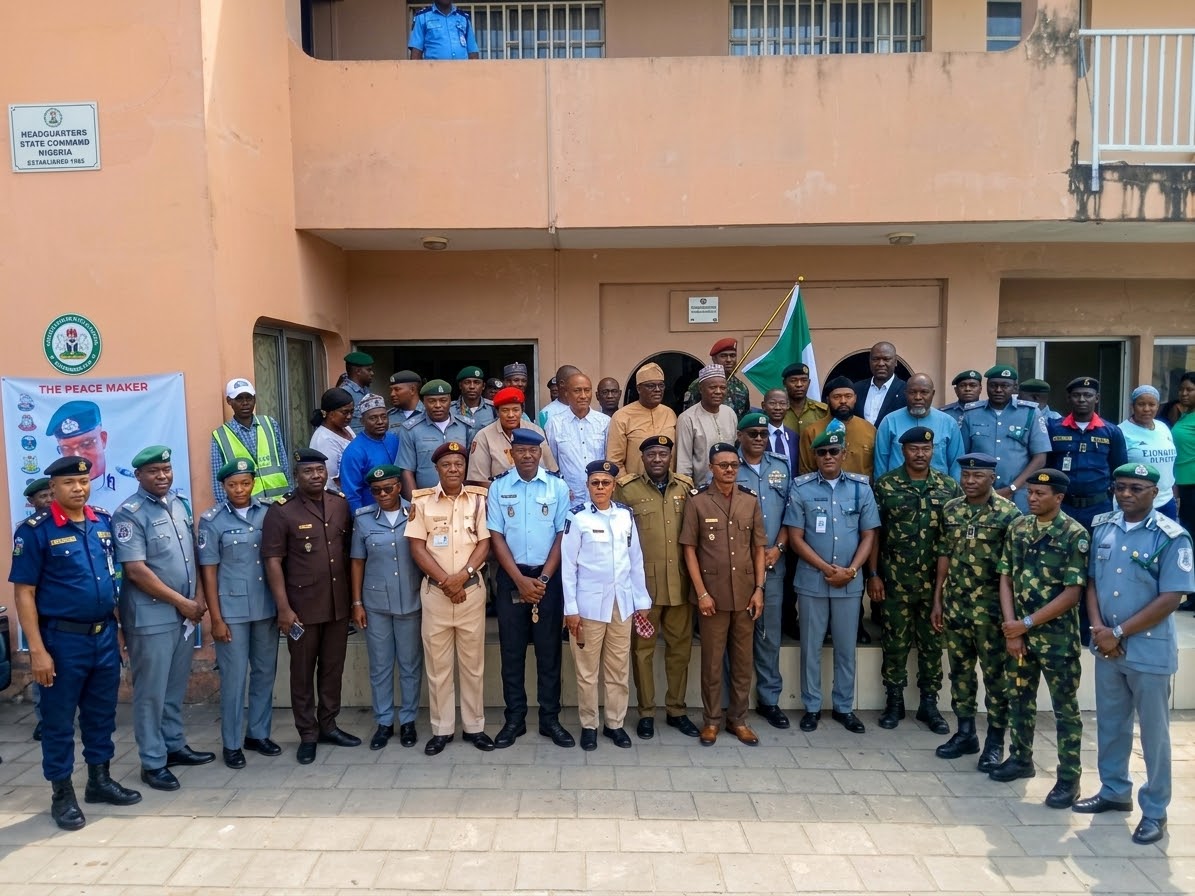
…As new controller, Deputy Comptroller N. Olisa Alumanah, pledges continuity in border security, trade facilitation
By Adebola Muili
The Nigeria Customs Service (NCS), Seme Area Command, generated more than ₦27 billion between March and October 2026, representing an approximately 235 per cent increase over the about ₦8 billion collected during the corresponding period in 2025.
The outgoing Customs Area Controller, Kaila Shuaibu, disclosed this while delivering his farewell address at the handover ceremony marking his elevation to the rank of Assistant Comptroller-General (ACG) and appointment to the NCS Management Board on Wednesday, 11th November 2026.
Shuaibu attributed the improved revenue performance to better management, improved compliance, stronger operational procedures, effective monitoring of trade activities and stricter enforcement of Customs regulations.

He explained that the achievement was not the product of individual efforts but the result of deliberate planning, professional commitment, intelligence gathering, effective supervision and the dedication of officers and men of the command.
According to him, the command’s responsibility went beyond revenue generation to include the suppression of smuggling, protection of the country’s economic interests and prevention of criminal activities across the border.
He noted that the command recorded significant seizures of illicit drugs and prohibited goods during his tenure, stressing that the interceptions helped prevent harmful and unlawful products from entering Nigerian communities, with potential implications for public health and national security.
The outgoing controller also identified intelligence gathering, proper information processing, surveillance and timely sharing of actionable intelligence as important factors behind the command’s operational achievements.
He said effective border management required more than the interception of prohibited goods, adding that security agencies must be able to identify threats, analyse information, anticipate criminal movements and prevent unlawful activities before they occur.

Shuaibu, who described inter-agency cooperation as one of the most significant aspects of his tenure, expressed appreciation to the Department of State Services (DSS), Nigerian Army, Nigerian Navy, Nigerian Air Force, Nigeria Police Force, Nigeria Immigration Service, National Drug Law Enforcement Agency (NDLEA), National Agency for Food and Drug Administration and Control (NAFDAC), Standards Organisation of Nigeria (SON) and other government institutions operating in the border area.
He said the collaboration among the agencies strengthened intelligence exchange, coordinated operations and collective responses to security threats, while contributing to a more peaceful and stable operating environment.
He warned that criminal networks often exploited gaps in coordination among security and regulatory institutions, stressing that effective border security depended on sustained cooperation and shared responsibility.
The importance of the collaboration was further illustrated by a representative of one of the security agencies, who cited the interception of a truckload of fertiliser brought into Nigeria from Ghana.
According to the representative, the consignment was presented as biofertiliser, but concerns were raised over its actual composition and potential security implications.

The representative explained that the matter was reported to Shuaibu at night, following which the consignment was flagged and a stop notice issued to prevent its clearance.
He said the intervention subsequently attracted the attention of a team from the Office of the National Security Adviser, which visited the command to examine the consignment and verify the action taken by Customs.
The representative said the incident demonstrated the importance of intelligence sharing and prompt cooperation among agencies in addressing security threats at the nation’s borders.
He commended Shuaibu for providing an environment in which agencies could work together, exchange information and respond collectively to operational challenges.
Also paying tribute to the outgoing controller, a representative of the DSS described him as an officer who demonstrated commitment to excellence and professionalism, noting that his leadership was reflected in his ability to bring out the best in people working with him.

The representative said leadership was not simply about exercising authority but about improving the capacity of others to perform, while wishing Shuaibu success in his new assignment.
Another stakeholder recalled Shuaibu’s contributions to public health interventions during an Ebola outbreak, explaining that he convened stakeholders, facilitated training for relevant personnel and community members, and provided his official vehicle to support emergency response activities.
The representative said the controller’s intervention helped public health officials overcome logistical difficulties at a critical period when support was needed to coordinate activities and facilitate the movement of personnel.
He also recalled Shuaibu’s engagement with traditional rulers, market representatives and other community stakeholders, describing his approach as one that encouraged cooperation and strengthened relationships between the command and the communities it served.
In his farewell address, Shuaibu expressed appreciation to the Comptroller-General of Customs, Adewale Adeniyi, MFR, for the confidence reposed in him and the opportunity to serve in the command.
He also commended officers and men of the command for their commitment, loyalty and sacrifices, noting that their willingness to work as a team contributed significantly to the achievements recorded during his tenure.

He urged them to sustain the discipline, integrity, professionalism and teamwork that characterised their operations, adding that the command’s progress should not be disrupted by the change in leadership.
Shuaibu equally appealed to traditional rulers, community leaders, traders, transport operators, licensed Customs agents, business associations and other stakeholders to maintain their cooperation with the Service.
He said constructive engagement with border communities and business operators remained essential to effective Customs administration, legitimate trade facilitation and the maintenance of security.
Meanwhile, the incoming Acting Customs Area Controller, Seme Area Command, Deputy Comptroller N. Olisa Alumanah, has pledged to sustain the achievements recorded by his predecessor while strengthening revenue generation, trade facilitation, discipline and operational efficiency.
In his assumption-of-office address, Alumanah expressed appreciation to the Comptroller-General of Customs and the management of the Service for finding him worthy of the responsibility, assuring that he would justify the confidence reposed in him through committed leadership and measurable results.
He acknowledged Shuaibu’s contributions to the command, particularly in revenue growth, intelligence collaboration, anti-smuggling operations and the establishment of a disciplined and professionally driven working environment.
Outlining his priorities, the new controller identified revenue generation as one of the major responsibilities of the command, stressing that all legitimate revenue due to the Federal Government must be collected in accordance with existing regulations.
He warned that his administration would not tolerate revenue compromise, deliberate negligence, improper valuation or any practice capable of depriving the government of its legitimate earnings.
Alumanah, however, emphasised that revenue collection must go hand in hand with the facilitation of legitimate trade, noting that Customs operations should not become a source of unnecessary frustration for genuine businesses.
He said officers must conduct their dealings with traders, agents and other stakeholders professionally, transparently and in accordance with the law.
He also warned against intimidation, extortion, deliberate obstruction and other unprofessional conduct, stressing that the Service’s responsibility was to collect legitimate revenue and enforce compliance without creating avoidable difficulties for legitimate operators.
On discipline and operational conduct, Alumanah said officers must respect the chain of command, observe established procedures, maintain punctuality and demonstrate professionalism in the discharge of their duties.
He declared that indiscipline, insubordination, extortion, abuse of office and unauthorised absence would not be tolerated, adding that no officer would be above accountability, regardless of rank, position or personal relationships.
The incoming controller further sought the cooperation of officers and men, emphasising that the success of the command would depend on teamwork, mutual respect and collective responsibility rather than unhealthy rivalry or personal interests.
He also pledged to strengthen collaboration with sister agencies, traditional institutions, transport operators, licensed Customs agents, importers, exporters and other stakeholders.
According to him, effective border management cannot be achieved by any single agency working in isolation, making information sharing, intelligence cooperation and constructive stakeholder engagement indispensable.
He, however, cautioned that collaboration must not translate into compromise, insisting that neither the law nor the mandate of the Service would be sacrificed for personal or external interests.
Alumanah also urged officers to avoid unnecessary problems arising from careless decisions, improper conduct and avoidable confrontations with stakeholders, advising them to follow established procedures, document their activities and seek clarification whenever necessary.
He further identified modernisation, innovation and the adoption of global best practices as important areas of focus, urging officers to embrace new systems, continuous training, improved technology and professional development to enhance revenue collection, intelligence gathering, risk management and enforcement.
Assuring officers and stakeholders of his leadership commitment, he said he would provide the necessary direction and support, encourage hard work, promote professionalism and ensure fairness while demanding accountability and results.
Setting out his leadership philosophy, Alumanah declared: “I am here to lead, not to intimidate, to support, not to encourage indiscipline, and to deliver results, not to negotiate standards.”
He added that his door would remain open to genuine concerns, while the rules governing the Service would be applied fairly.
The new controller expressed confidence in the capacity of the command to distinguish itself through improved performance, discipline, responsiveness and effective collaboration, calling on officers, sister agencies and stakeholders to work with him towards achieving the objectives of the Service.
Discover more from SAFARI XPRESS NEWS
Subscribe to get the latest posts sent to your email.












Leave a Reply